Archaeologists explore Ningbo's twin cradles of civilization
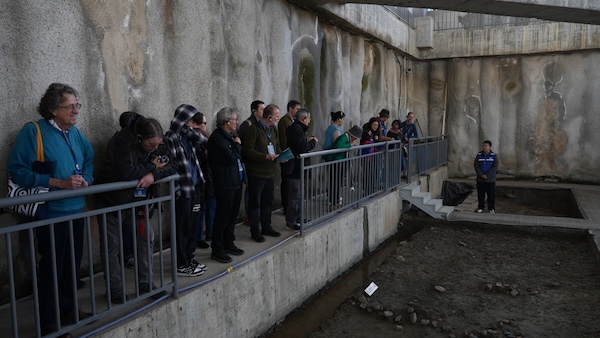
Experts visit the Jingtoushan site. [Photo/Yongpai App]
During the 6th Shanghai Archaeology Forum, 139 scholars from China and abroad traveled to Ningbo on Dec 15 to study two landmark sites: Jingtoushan and Hemudu. Together, they reveal how maritime and agrarian traditions intertwined to shape early Chinese civilization.
Jingtoushan, Zhejiang's first shell mound site, is the earliest and deepest coastal midden discovered in southeastern China. Excavations have uncovered pottery, shell tools, and wooden paddles, vividly portraying how ancient communities lived by the sea 8,000 years ago.
Chris Gosden from University of Oxford marveled at the site's scale, noting its vast remains suggest a large settlement. Chinese experts hailed Jingtoushan as vital to understanding the origins of maritime culture in the Yangtze River basin, though its deep burial poses preservation challenges.
Hemudu, meanwhile, is celebrated as the birthplace of rice cultivation. More than 6,000 artifacts — including rice grains, pottery, and stilted wooden building remains — have reshaped knowledge of China's early farming and architecture.
The Hemudu Site Museum, covering 560,000 square meters, brings history to life through reconstructions and displays. Professor Liu Hui emphasized that the rice remains prove that the Yangtze River basin was a cradle of agriculture, while international scholars highlighted parallels with Southeast Asia's early traditions.
The Ningbo field study was both a journey across millennia and a vivid dialogue between cultures. By juxtaposing Jingtoushan's maritime legacy with Hemudu's agrarian heritage, scholars gained deeper insight into the roots of Chinese civilization.
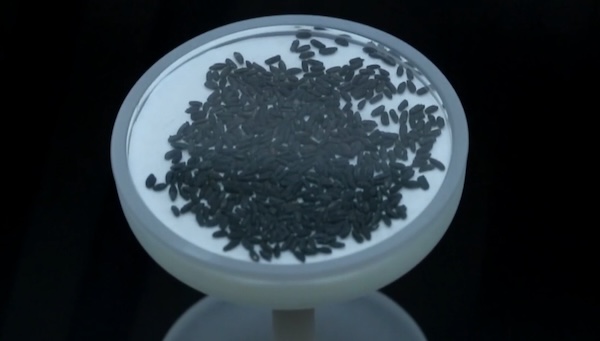
Carbonized rice grains unearthed from the Hemudu site. [Photo/Yongpai App]
 Why global travelers favor China high-speed rail?
  A look at China's economic data in H1
  A fun way to capture summer in Ningbo