
Sharing economy a rising star despite COVID woes
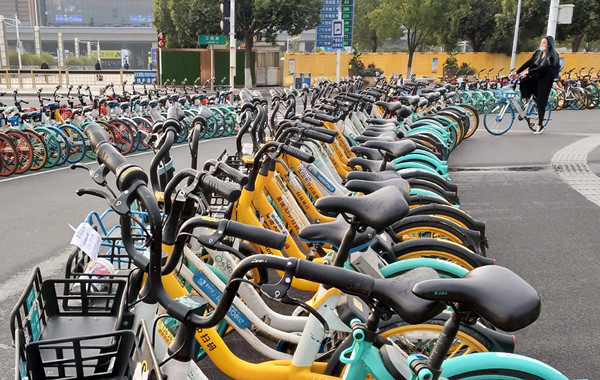
A rider parks a shared bicycle at a parking lot earmarked for shared bikes in Nanjing, Jiangsu province, in October. [Photo by Wang Qiming/For China Daily]
The growth rate of China's sharing economy sector is expected to be between 10 and 15 percent this year, and maintain an average annual growth rate of over 10 percent in the coming five years, thanks to an expected strong recovery in the macroeconomy, a recent report said.
The State Information Center said that in 2020, amid challenges brought by COVID-19, new business modes featuring the sharing economy demonstrated tremendous resilience and development potential. The trade volume of the sharing economy for the year surged 2.9 percent year-on-year to 3.38 trillion yuan ($523.6 billion).
The pandemic's influence on different areas of the sharing economy varied. The market volume of the sharing healthcare sector grew rapidly, with year-on-year growth of 27.8 percent. In contrast, the market volume of sharing accommodation, office-space and transportation dropped by 29.8 percent, 26 percent and 15.7 percent, respectively, because the areas required offline activities to complete a closed transaction loop.
"Sharing services and new consumption modes had been playing a critical role in boosting national economic resilience and vitality. Meanwhile, sharing economy platforms were constantly innovating business strategies and marketing modes, thus demonstrating various advantages," said the report.
It said that in 2020, one major change for the country's sharing economy sector was that more and more enterprises, which mainly served the consumer-end, expanded their businesses to the business-end.
Xiaozhu, a Beijing-based sharing accommodation website/app, signed a strategic partnership with Bytedance's enterprise service platform Feishu last year, offering accommodation solutions, such as accommodation for business trips, corporate teambuilding exercises and training conferences for registered enterprises on Feishu.
Ziyouxin, a flexible employment platform under Tencent's finance and taxation technology arm GoldenTec, actively responded to surging hiring requirements of enterprises during the pandemic period. In February of last year, it launched an emergency recruitment service called "shared employees", offering more than 10,000 workers to enterprises, including Guangzhou Wondfo Biotech Co Ltd, Bluemoon, Wumart Group, iShansong and Yaofangwang.
Another new feature highlighted in the report was that the sharing economy was further integrated with internet-based marketing approaches, creating more platform-user interaction and user stickiness.
 Expats enjoy festive fun in Ningbo
  Horse motifs in China's intangible cultural heritage
  International friends join Chinese New Year festivities in Ningbo