
Ningbo's Qing'an Guild Hall reopens after restoration
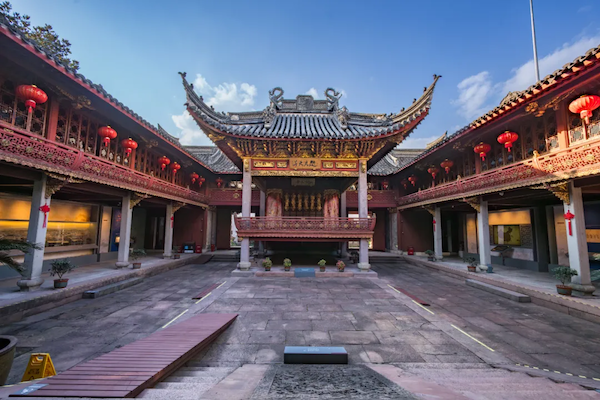
The Qingan Guild Hall in Ningbo, Zhejiang province. [Photo/WeChat account: gotoningbo]
The Qingan Guild Hall, a nationally protected cultural relic and part of the UNESCO-listed Grand Canal, will reopen to the public on Dec 8 following a yearlong restoration project.
The restoration project enlisted masters of intangible cultural heritage to restore gold-lacquered wood carvings, raw lacquer, and clay sculpture.
Traditional methods were revived while integrating modern conservation science. For example, artisans collaborated with the Nanjing Museum on protective experiments for woodcarvings, while lacquer experts from the Palace Museum guided craftsmen with over 50 years of experience.
Situated at 156 Jiangdongbei Road, where three rivers converge, the hall spans nearly 10,000 square meters. Built between 1850 and 1853, it served both as a merchant guild hall and a temple to Mazu, goddess of the sea. Its rare dual-stage layout, grand scale, and over 1,000 gold-lacquered wood carvings exemplify the peak of eastern Zhejiang's artistry in the Qing Dynasty (1644–1911) era.
The hall reflects Ningbo's canal culture and maritime heritage, symbolizing the rise of merchant guilds and the city's role in river-sea trade. It was recognized as a national key cultural relic in 2001 and became part of the Grand Canal World Heritage site in 2014.
Opening hours: Tuesday to Sunday, 8:30 am to 4:30 pm (ticket sales stop at 4:00 pm); closed on Mondays except holidays
Admission: 10 yuan ($1.41)
Address: No 156 Jiangdongbei Road, Yinzhou district, Ningbo
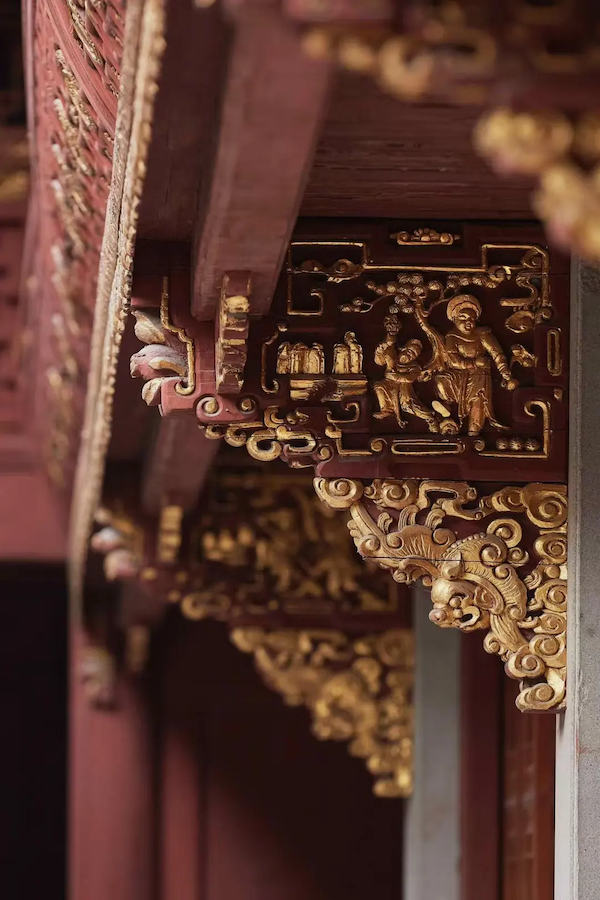
A close-up of wood carvings at the Qingan Guild Hall. [Photo/WeChat account: gotoningbo]
 Why global travelers favor China high-speed rail?
  A look at China's economic data in H1
  A fun way to capture summer in Ningbo